The best santoku knives balance comfortable control with a blade suited to the prep you do most, from chopping vegetables to slicing fish. These picks range from compact storage-friendly designs to longer, clad-steel blades, so consider blade length, grip, and care before choosing.
Quick Top Products
imarku 7-Inch Santoku, 10Cr15CoMoV
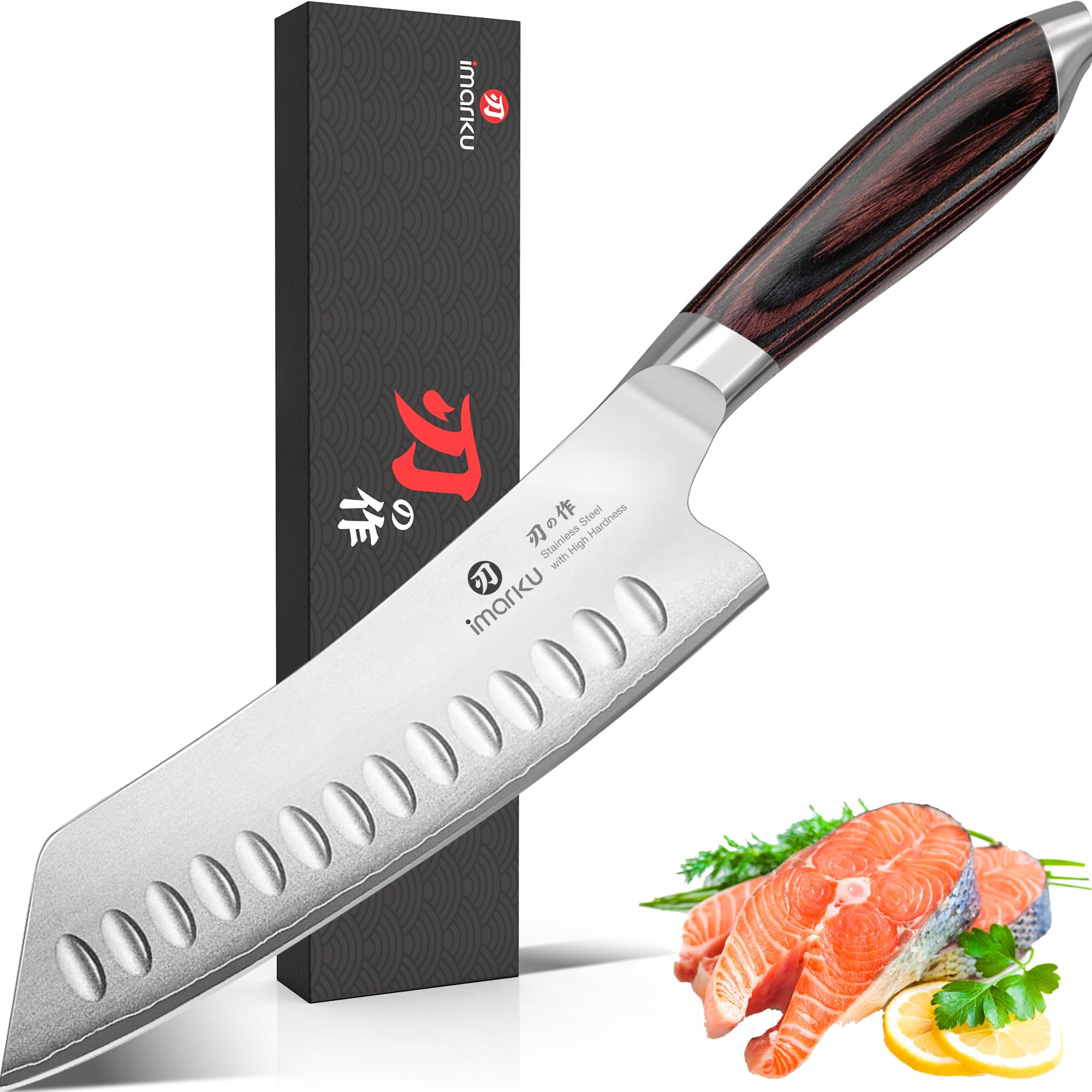
- A 7-inch 10Cr15CoMoV core has protective stainless steel cladding.
- Hollow-edge dimples are designed to reduce drag with moist foods.
- The raised Pakkawood handle offers knuckle clearance.
Best For: Home cooks who want a general-purpose santoku with a raised handle and hollow-edge blade.

KEEMAKE 7-Inch Santoku
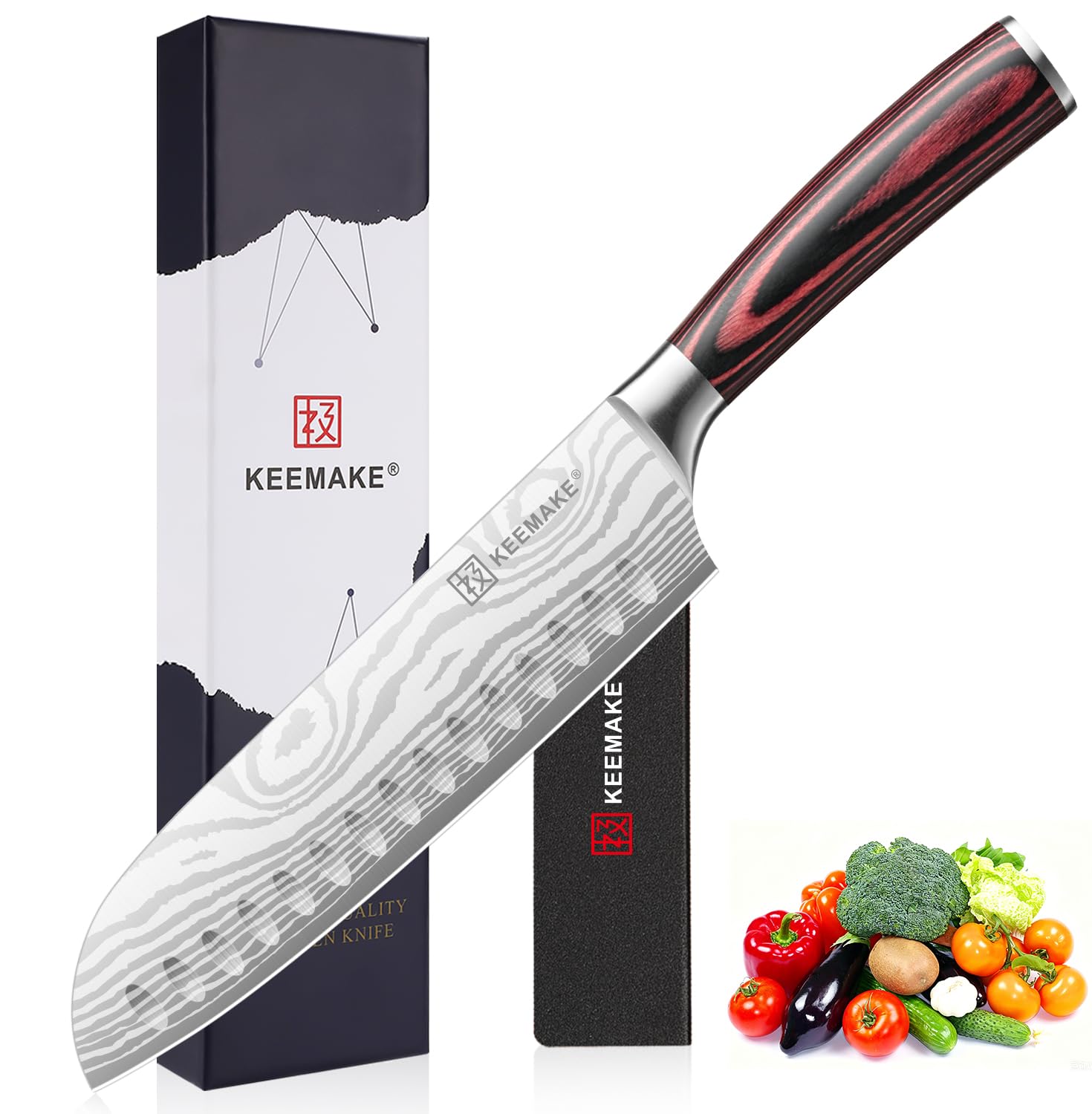
- The 7-inch knife weighs 8.16 oz.
- Its 1.4116 steel blade has a 12–15° edge per side.
- A wave-patterned blade is designed to reduce sticking.
Best For: Cooks who prefer a lighter 7-inch knife for quick prep and push cutting.
imarku 7-Inch Powder Steel Santoku
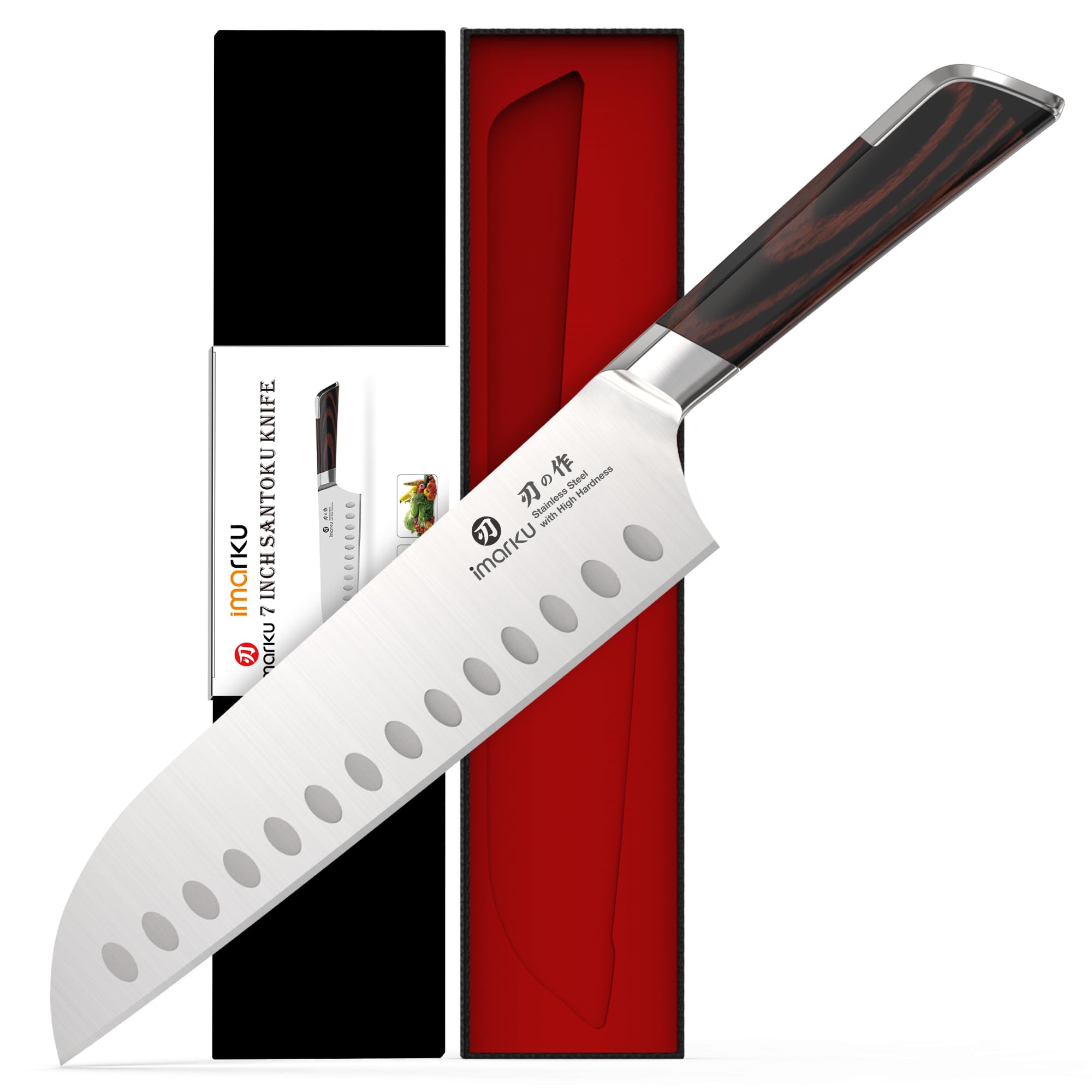
- The 7-inch blade is forged from powder steel.
- Its contoured Pakkawood handle has a diamond profile.
- A mirror-finished bolster is designed for balance.
Best For: Cooks interested in a forged powder-steel blade and a contoured Pakkawood grip.
Zyliss Comfort 5.9-Inch Santoku
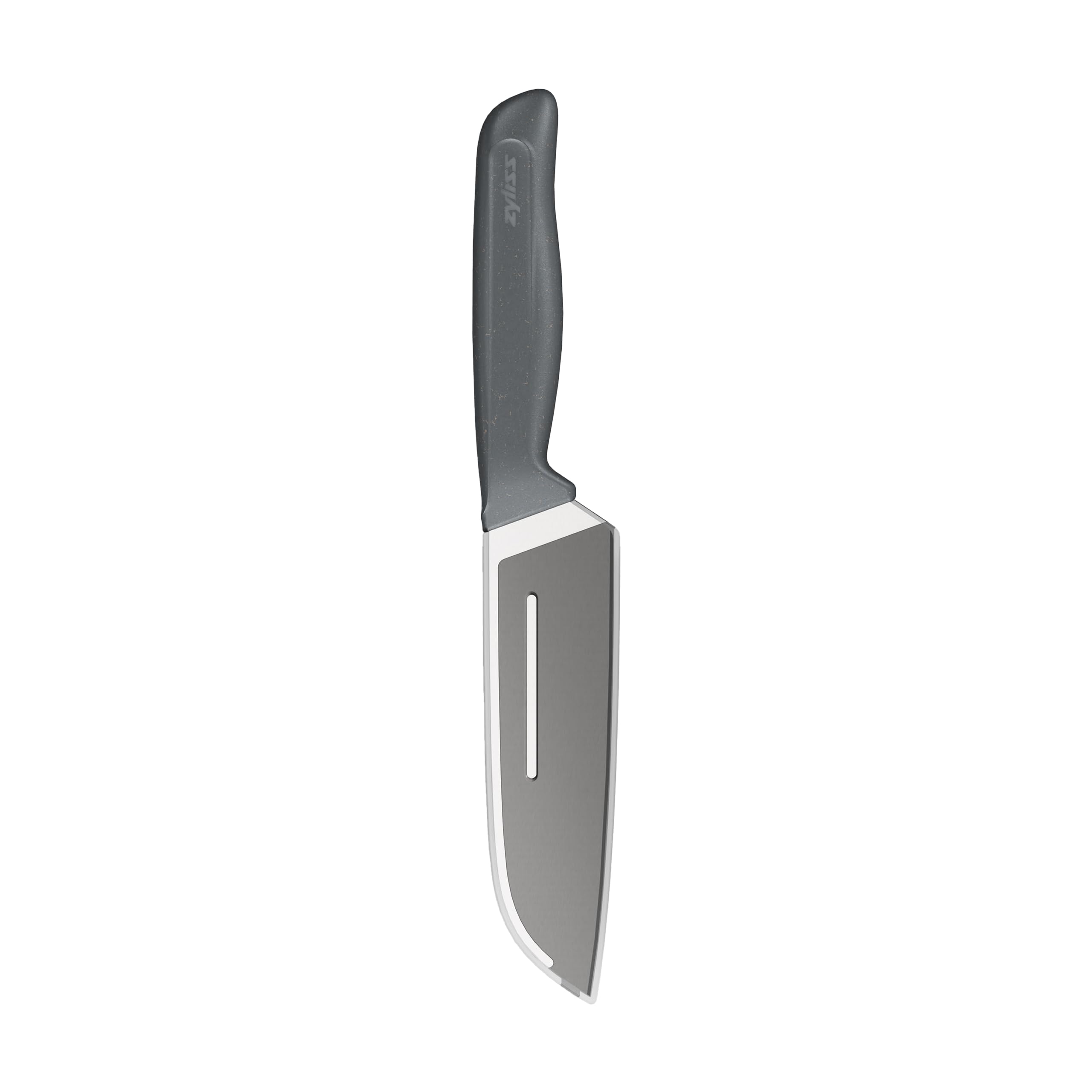
- The santoku blade measures 5.9 inches.
- It includes a protective blade guard for storage or camping.
- Its handle is contoured and non-slip.
Best For: Cooks seeking a shorter santoku with a blade guard for drawer storage or camping.
imarku 7-Inch Santoku, High-Carbon Steel
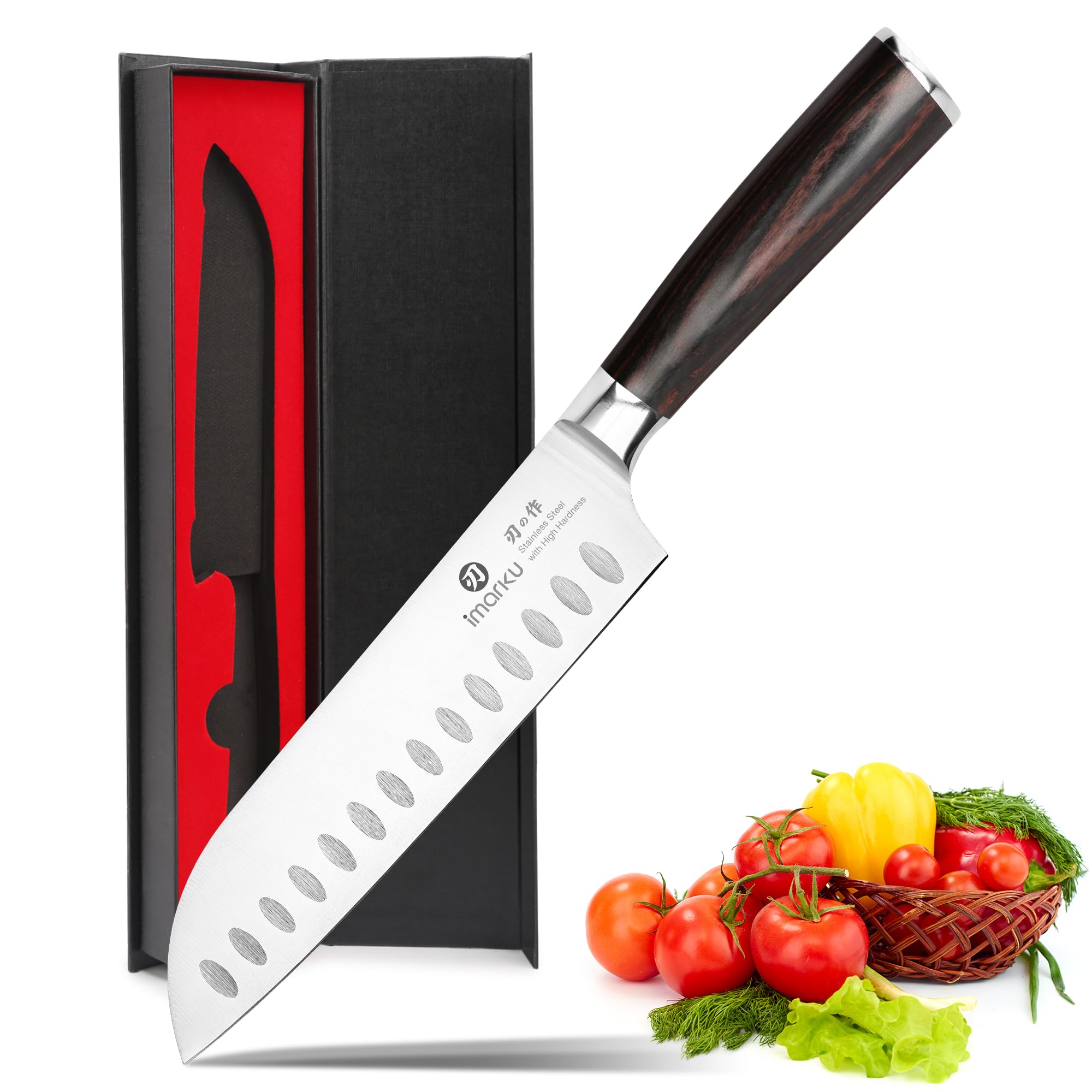
- It has a 7-inch high-carbon stainless steel blade.
- The scalloped hollow edge is designed to reduce sticking.
- The edge is 15–18 degrees per side.
Best For: Home cooks who want a 7-inch santoku with a hollow edge and familiar Pakkawood handle.
imarku 7-Inch Santoku, Blue Handle
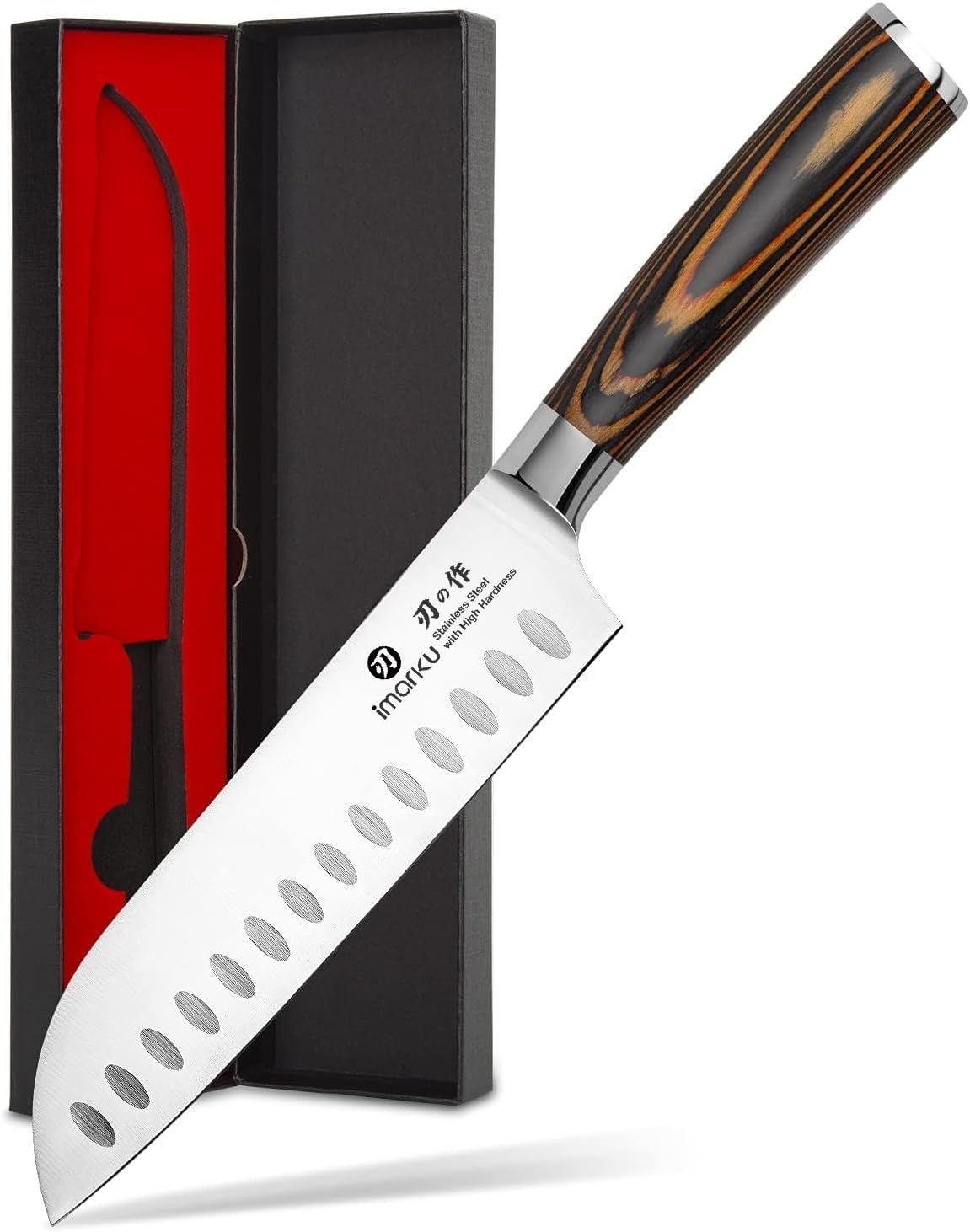
- It has a 7-inch blade with hollow ovals on both sides.
- The handle is blue and ergonomically designed.
- The edge angle is 15–18 degrees per side.
Best For: Cooks who want a colorful handle and a hollow-edge blade for routine prep.
imarku 7-Inch Santoku, Sand-Grinding Finish
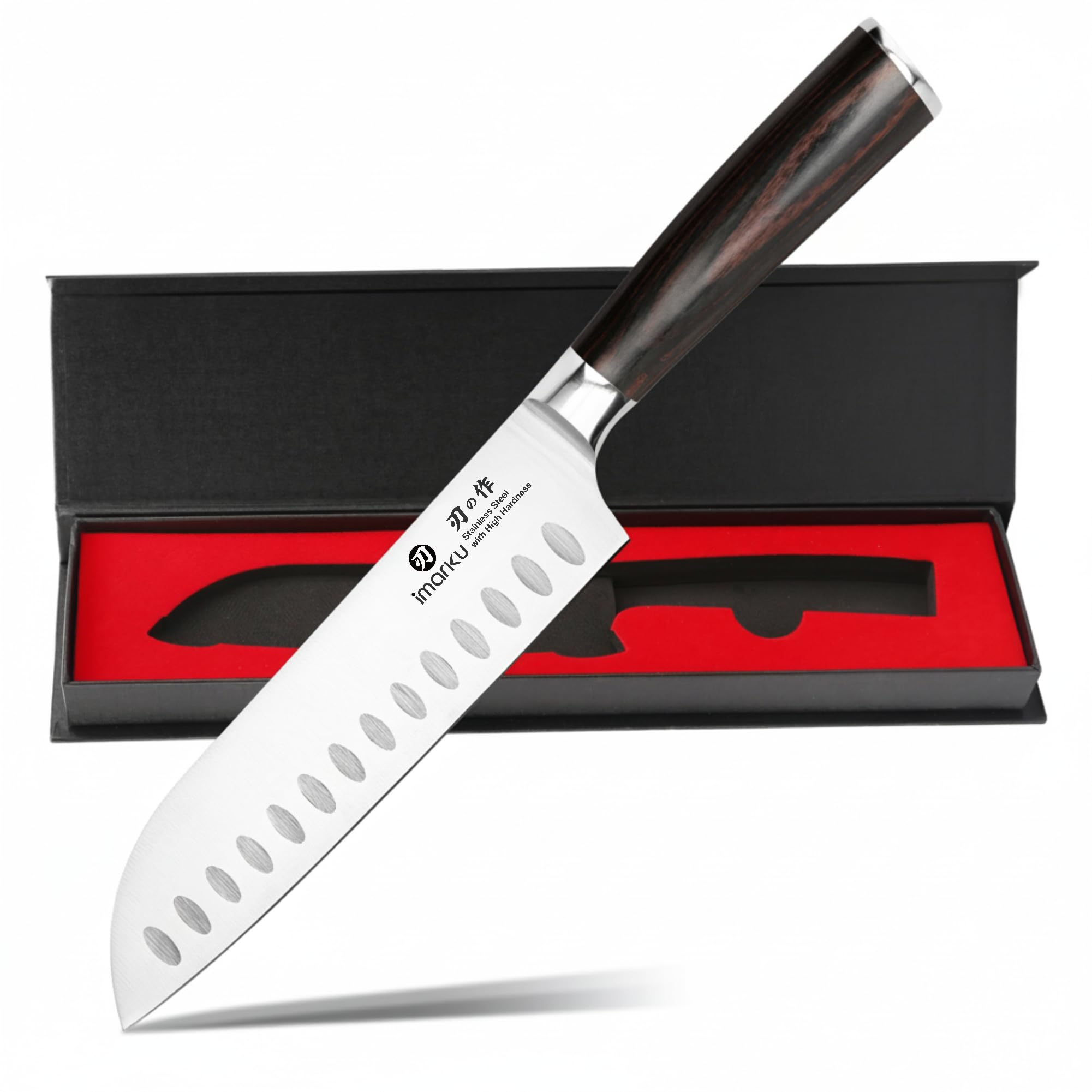
- The knife weighs 190 g.
- A hollow blade design is intended to reduce sticking.
- It has a Pakkawood handle.
Best For: Cooks seeking a lighter santoku with a Pakkawood grip for quick kitchen tasks.
Clad Steel for Daily Prep
imarku Japanese Santoku Knife 7 Inch, 10Cr15CoMoV 3-Layer Stainless Steel
This imarku pairs a 7-inch blade with a 10Cr15CoMoV stainless steel core and protective cladding. Its hollow-edge dimples are intended to reduce drag with moist or starchy ingredients, while the raised Pakkawood handle provides knuckle clearance at the board.
The 12±2° edge is a relatively specific sharpening detail for buyers comparing blade geometry. It suits everyday slicing, dicing, and mincing across vegetables, boneless meat, and fish.
The handle and clad construction make it a practical all-rounder, though care instructions are not specified, so check how the knife should be washed and maintained before buying.
Best For: Home cooks who want a general-purpose santoku with a raised handle and hollow-edge blade.
| Pros | Cons |
|---|---|
|
|
Choose this knife if you want a full-size santoku with explicit steel construction and a handle shaped for board clearance. The hollow-edge design may suit frequent work with potatoes, onions, and other ingredients that can cling.
Before buying, check whether the knife is intended for hand washing and what sharpening approach suits its edge; those care details are not specified. Its 7-inch blade and 12±2° edge are the key fit details to weigh against a shorter or broader-handled option.
Lightweight, Nimble Handling
KEEMAKE 7" Santoku Knife, Razor Sharp Chef Knife with Ergonomic Handle
The KEEMAKE santoku combines a 7-inch blade with a stated weight of 8.16 oz, giving shoppers concrete dimensions to consider when choosing a manageable knife. It uses 1.4116 high-carbon stainless steel and a hand-sharpened 12–15° edge per side.
The wave-patterned blade is intended to reduce food sticking, and the Pakkawood handle is shaped for a secure hold. Its profile supports slicing, dicing, mincing, and push cuts, with some rocking at the tip.
That mix makes it a flexible daily-prep choice for cooks who find a larger chef knife bulky.
Best For: Cooks who prefer a lighter 7-inch knife for quick prep and push cutting.
| Pros | Cons |
|---|---|
|
|
Consider the KEEMAKE if you value a clearly specified weight and want a 7-inch santoku for agile everyday prep. Its profile includes push cuts and limited rocking, so it can cover several common techniques without taking the place of every specialized knife.
The wave pattern addresses food release, while the 1.4116 steel and 12–15° edge are the main construction details to compare. Check the recommended care and sharpening routine before purchase, as those details are not specified.
Powder-Steel Construction
imarku Japanese Santoku Knife 7 Inch, Ultra Sharp Chef Knife, Professional Grade Powder High Carbon Steel Forged Kitchen Knife, PakkaWood Ergonomic Handle, Gifts for Women and Men
This 7-inch imarku stands out for its powder-steel construction and forged design. The product notes give a hardness of HRC 62±1 and describe a mirror-finished bolster intended to balance the blade and handle.
Its diamond-profile Pakkawood handle is shaped for grip, while the blade is described as stain-resistant and corrosion-resistant. The maker also gives an edge-retention figure on the TCC scale, but that is a product-specific claim rather than a directly comparable measure here.
This option may interest cooks prioritizing its steel and finish details; confirm care guidance and what the edge-retention figure means for your use.
Best For: Cooks interested in a forged powder-steel blade and a contoured Pakkawood grip.
| Pros | Cons |
|---|---|
|
|
Pick this imarku if powder-steel construction, a forged blade, and a contoured Pakkawood grip are high on your list. Its HRC and TCC figures offer additional specifications, but the TCC claim is difficult to compare with knives that use other measures.
Focus on the concrete blade and handle details, then check care instructions before buying. The record does not give a washing or sharpening routine, which matters when comparing a specialty steel option with simpler everyday knives.
Compact, Sheath-Included Option
Zyliss Comfort Knife - Japanese Stainless Steel Blade - Non-Slip Contoured Handle for All Hand Sizes - Kitchen Tools with Safety Kitchen Blade Guards - Dishwasher Safe - 5.9" Santoku Knife
At 5.9 inches, this Zyliss santoku has a compact blade for cooks who prefer a shorter format. It has a Japanese stainless steel blade, a contoured non-slip handle, and finger indents intended to support a controlled grip across hand sizes.
A protective blade guard makes it suitable for drawer storage or packing for camping. The product title also gives dishwasher-safe care as a feature.
If you want more reach for broad board work, compare its shorter format carefully; otherwise, the guard and grip details offer a practical everyday combination.
Best For: Cooks seeking a shorter santoku with a blade guard for drawer storage or camping.
| Pros | Cons |
|---|---|
|
|
This is a sensible fit if compact storage, a blade guard, or camping use matters more than having a longer blade. The 5.9-inch length is the main tradeoff against full-size santokus, while the contoured, non-slip handle and finger indents address grip.
Dishwasher-safe care is included in the product title, but check the maker’s guidance for the sheath and handle before cleaning. Choose it for a compact role or smaller prep space, and compare its reach with your usual cutting board tasks.
Hollow Edge for Everyday Slicing
imarku Chef Knife 7 Inch Kitchen Knife Ultra Sharp Santoku Knife - High Carbon Japanese Chefs Knife, Kitchen Gadgets 2025, Apartment Essentials, Birthday Gifts for Him Her, Best Gifts for Women Men
This imarku has a 7-inch high-carbon stainless steel blade, a hollow edge, and an ergonomic Pakkawood handle. The scallops are designed to create gaps between the blade and food, helping reduce sticking during slicing, dicing, and mincing.
Its hand-polished edge is given as 15–18 degrees per side, and the product notes specify a 2.5 mm blade thickness. Those details make it easier to compare with knives that publish edge geometry and thickness.
The knife is described for work with meat, vegetables, fruit, and bread. Check the care routine and sharpening guidance if you want to assess upkeep before choosing.
Best For: Home cooks who want a 7-inch santoku with a hollow edge and familiar Pakkawood handle.
| Pros | Cons |
|---|---|
|
|
Choose this imarku if you want the familiar 7-inch santoku format and value a hollow edge for foods that may cling. Its 15–18° per-side edge and 2.5 mm thickness give more concrete comparison points than a description focused only on general sharpness.
The Pakkawood handle is another practical feature for routine prep. Before buying, check care and sharpening guidance; the product notes do not give a maintenance routine.
It fits cooks seeking a straightforward all-purpose blade rather than specialized steel details.
Blue Handle and Hollow Blade
imarku Santoku Knife, 7 inch Kitchen Knife Ultra Sharp Cooking Knife Japanese Chef Knife -High Carbon Stainless Steel - Ergonomic Pakkawood Handle, Gifts for Women/Men, Orange
This 7-inch imarku santoku combines a blue ergonomic handle with a hollow oval edge on both sides of the blade. The product notes identify German high-carbon stainless steel and an edge angle of 15–18 degrees per side.
The hollow design is intended to help vegetables and meat release from the blade, while the handle is shaped to reduce grip pressure. It is presented for chopping, slicing, dicing, and mincing across ordinary kitchen ingredients.
Its notable distinction within the imarku choices is the blue handle. Check which handle finish you prefer and confirm care instructions before adding it to a kitchen set.
Best For: Cooks who want a colorful handle and a hollow-edge blade for routine prep.
| Pros | Cons |
|---|---|
|
|
This option suits shoppers who want the same broad everyday santoku role with a blue handle as a visible distinction. Its 7-inch blade, hollow oval design, and 15–18° edge are the useful functional details to weigh.
The records do not specify a care routine, so check washing and sharpening advice before purchase. If handle color is not a priority, compare its shared general-purpose features with other imarku models here and decide based on the blade construction and grip you prefer.
Lightweight Santoku for Quick Tasks
imarku Santoku Knife 7 Inch Japanese High Carbon Stainless Steel Chef Knife | Japanese Style Sharp Kitchen Knife Sand Grinding Finish Effortless Prep Meats And Vegetables Best Gifts For Women And Men
This imarku santoku is described as weighing 190 g and uses a high-carbon stainless steel blade with a Pakkawood handle. The hollow blade is designed to create air pockets that may reduce sticking, while the sand-grinding finish distinguishes its surface treatment from the other imarku options.
Its edge is given as 28+ degrees on each side, a detail to compare carefully with other published edge angles because the conventions may differ. The product is intended for everyday cutting of vegetables, fruit, and meat.
Confirm the actual blade length and care guidance before buying, since the notes do not clearly provide either detail.
Best For: Cooks seeking a lighter santoku with a Pakkawood grip for quick kitchen tasks.
| Pros | Cons |
|---|---|
|
|
Consider this option if you are interested in a stated 190 g weight and a hollow blade intended to reduce sticking. The Pakkawood handle and sand-grinding finish provide additional design details, but the edge-angle figure of 28+ degrees on each side is not directly comparable unless its measurement convention is clear.
Most importantly, confirm the blade length for this specific offer before purchase; it is absent from the notes. Also check care guidance, since a maintenance routine is not provided.
How to Choose Santoku Knives
How We Picked Best Santoku Knives
We selected knives explicitly identified as santokus and prioritized useful differences for everyday chopping and slicing: blade length, steel construction, edge or hollow-edge details, grip, and storage features. The group includes standard 7-inch options, a shorter 5.9-inch knife with a blade guard, and models with more specific information about steel, handle shape, or weight.
These distinctions help match a knife to the cook’s prep habits instead of treating every santoku as interchangeable.
We excluded one conflicting offer because its title and notes describe a paring knife while its catalog title calls it a santoku. The imarku entries share a brand, but their records give distinct construction, handle, or finish details; compare those specifics and verify the exact offer before purchase.
Comparing Santoku Knives for Everyday Prep
The most useful first comparison is blade length. Most options here use a 7-inch blade, while the Zyliss is 5.9 inches and may suit cooks who prefer a shorter reach or want the included guard for storage.
The KEEMAKE provides a stated 8.16 oz weight, and another imarku gives a 190 g figure; these are useful handling references, though the knives’ overall balance and dimensions differ.
Steel and blade construction also vary. One imarku uses a 10Cr15CoMoV core with stainless cladding, while the powder-steel model provides an HRC figure.
Other choices specify 1.4116 or high-carbon stainless steel. Hollow edges and wave patterns are intended to help food release, while a plain spec sheet cannot establish which design will feel best with your ingredients.
Compare handle shape, edge details, and care instructions alongside the steel name.
| Product | Standout features | Best for |
|---|---|---|
| imarku 7-Inch Santoku, 10Cr15CoMoVCheck Price |
| Home cooks who want a general-purpose santoku with a raised handle and hollow-edge blade. |
| KEEMAKE 7-Inch SantokuCheck Price |
| Cooks who prefer a lighter 7-inch knife for quick prep and push cutting. |
| imarku 7-Inch Powder Steel SantokuCheck Price |
| Cooks interested in a forged powder-steel blade and a contoured Pakkawood grip. |
| Zyliss Comfort 5.9-Inch SantokuCheck Price |
| Cooks seeking a shorter santoku with a blade guard for drawer storage or camping. |
| imarku 7-Inch Santoku, High-Carbon SteelCheck Price |
| Home cooks who want a 7-inch santoku with a hollow edge and familiar Pakkawood handle. |
| imarku 7-Inch Santoku, Blue HandleCheck Price |
| Cooks who want a colorful handle and a hollow-edge blade for routine prep. |
| imarku 7-Inch Santoku, Sand-Grinding FinishCheck Price |
| Cooks seeking a lighter santoku with a Pakkawood grip for quick kitchen tasks. |
Choosing a Santoku Knife for Your Cutting Board
A santoku’s blade length affects reach and how much space it occupies across a board. A 7-inch blade is the common format in these picks; the shorter Zyliss may be easier to store or pack, but offers less blade length for broad ingredients.
Handle clearance matters too: the newer imarku clad-steel option specifies a raised handle for knuckle clearance, while KEEMAKE describes a shaped Pakkawood grip.
Consider how you cut. KEEMAKE describes a flatter edge for push cuts and a tip that allows limited rocking.
Hollow-edge dimples or scallops appear on several options and are intended to reduce drag or sticking with moist foods. If you often slice potatoes or onions, that feature may interest you; if you mainly chop herbs, compare how the blade profile and handle fit your technique.
Steel, Edge Geometry, and Knife Care
Published edge angles and hardness figures can help narrow choices, but only when the conventions are clear. The KEEMAKE and several imarku knives give per-side edge angles, while the powder-steel model gives an HRC figure and a TCC sharpness claim.
Treat these as product specifications, not as a direct ranking across different methods. Check what sharpening tools and routine are recommended for the specific knife you choose.
Care guidance is a meaningful gap in several records. The Zyliss title calls it dishwasher safe, while most other options do not specify washing instructions.
For any knife, verify the maker’s care directions and whether the handle and blade guard have separate cleaning requirements. A comfortable grip, manageable blade length, and care routine you will follow can matter as much as steel terminology in daily kitchen use.
Who Should Buy Which Santoku Knife
Choose the Zyliss if you want a shorter santoku and appreciate a blade guard for drawer storage or camping. Consider the KEEMAKE if its stated weight, 1.4116 steel, and wave-patterned blade suit your preferences.
The imarku 10Cr15CoMoV model is the clearest match for shoppers looking for a clad-steel core and raised handle, while the powder-steel option is for buyers drawn to its stated hardness and forged construction.
For a familiar 7-inch format with a hollow edge, compare the imarku high-carbon stainless models by handle appearance and the details that matter to you. The blue-handled version offers a color distinction, while the other specifies blade thickness and per-side edge angle.
The lighter imarku gives a stated weight, but its blade length is not specified, so confirm that detail before choosing it.